- English
- Español
- Português
- русский
- Français
- 日本語
- Deutsch
- tiếng Việt
- Italiano
- Nederlands
- ภาษาไทย
- Polski
- 한국어
- Svenska
- magyar
- Malay
- বাংলা ভাষার
- Dansk
- Suomi
- हिन्दी
- Pilipino
- Türkçe
- Gaeilge
- العربية
- Indonesia
- Norsk
- تمل
- český
- ελληνικά
- український
- Javanese
- فارسی
- தமிழ்
- తెలుగు
- नेपाली
- Burmese
- български
- ລາວ
- Latine
- Қазақша
- Euskal
- Azərbaycan
- Slovenský jazyk
- Македонски
- Lietuvos
- Eesti Keel
- Română
- Slovenski
- मराठी
- Srpski језик

The differences in flame retardant properties between PE and PVC
In the plastic processing and industrial application industry, polyethylene (PE) and polyvinyl chloride (PVC) are two of the most widely used general-purpose plastics, covering packaging, construction, agriculture, electrical insulation and industrial lining fields. Many purchasers and processors mistakenly believe that adding commercial flame retardants can completely eliminate the flammability of PE materials and enable PE to achieve the same flame-retardant level as modified PVC. However, a large number of authoritative material combustion tests and industrial standard verification prove that PE has inherent defects in flame-retardant performance that cannot be fundamentally eliminated. Even after high-dose flame retardant modification, PE materials can still burn continuously under sustained open fire and high-temperature conditions, and their comprehensive flame-retardant stability is far inferior to that of PVC. This article combines international combustion test data, polymer pyrolysis mechanism research and industry standard parameters to scientifically analyze the essential gap in flame retardancy between PE and PVC, and clarify the limitations of flame retardant modification for PE.
First of all, the fundamental difference in flame-retardant performance between PE and PVC stems from their molecular structure and inherent material properties, which is an unchangeable physical and chemical essence. According to the polymer combustion kinetic research published in the MDPI journal Fire in 2025, PVC contains 56.7% chlorine elements in its molecular chain, which is a natural halogen flame-retardant component without manual addition . In contrast, pure PE is composed entirely of carbon and hydrogen elements, with no inherent flame-retardant groups. It belongs to a typical highly flammable hydrocarbon polymer, with extremely low fire resistance and no self-extinguishing ability in its original state.
The Limiting Oxygen Index (LOI), the most core international index to evaluate material flammability, can intuitively reflect the gap between the two materials. The LOI test is based on the ISO 4589-2 standard, which refers to the minimum oxygen concentration required to support material combustion. The higher the LOI value, the harder the material is to burn. Authoritative test data from The Vinyl Institute shows that pure rigid PVC has an LOI value of 45%–48%, far exceeding the critical flame-retardant threshold of 28% . It can only burn stably in an oxygen-rich environment and has excellent self-extinguishing performance in natural air. In sharp contrast, pure PE has an LOI value of only 19.0%, which is lower than the 21% oxygen concentration in normal air . This means that pure PE can burn freely and continuously in conventional atmospheric environments, with almost no natural flame-retardant ability.
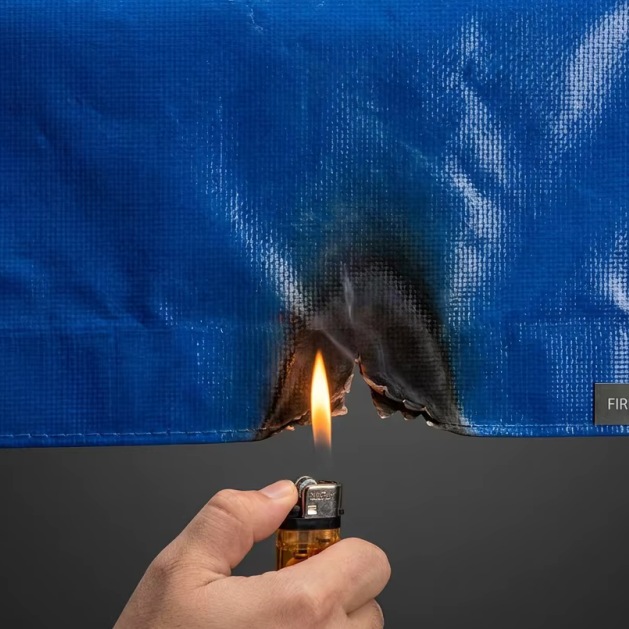
Many enterprises try to make up for PE’s flammability defects by adding inorganic and organic flame retardants such as ammonium polyphosphate (APP), magnesium hydroxide and aluminum hydroxide. However, experimental data proves that flame retardants can only slightly reduce the combustion speed and heat release of PE, but cannot make PE achieve non-combustible or stable flame-retardant effects, and modified PE can still burn violently under sustained open fire conditions. According to the 2025 research data from the Chinese Journal of Materials Science and Technology, even when PE is added with 25% high-efficiency composite flame retardant (the maximum proportion allowed by industrial processing technology), its LOI value can only be increased to 28.5%–30.2% . Although it reaches the primary flame-retardant standard in the short-term UL-94 vertical burning test, once the external flame lasts for more than 30 seconds, the modified PE will ignite completely, accompanied by continuous melting, dripping and spreading combustion. In comparison, ordinary unmodified PVC can self-extinguish within 2 seconds after leaving the fire source, with no dripping combustion phenomenon.
The essential reason why flame retardants cannot completely improve PE’s flame retardancy lies in the different pyrolysis and flame-retardant mechanisms of the two materials. According to the TG-FTIR-GC/MS combined test research on polymer pyrolysis kinetics, PVC relies on its internal chlorine elements to decompose and release hydrogen chloride (HCl) gas when heated . HCl can isolate oxygen, capture active combustion free radicals, and terminate the combustion chain reaction fundamentally. At the same time, PVC will form a dense and stable carbon layer on the surface during pyrolysis, which can block heat transfer and prevent internal materials from continuing to decompose and burn.
However, the flame-retardant mechanism of modified PE is completely passive. The flame retardant added to PE only plays a role of heat absorption and oxygen isolation in the superficial stage of combustion. When encountering continuous high temperature above 350℃, the PE molecular chain undergoes random scission, and the flame retardant will fail rapidly after high-temperature decomposition and loss . Moreover, PE will produce a large amount of molten droplets during combustion. These high-temperature molten drips will not only spread the flame but also accelerate the thermal decomposition of the remaining materials, forming a vicious cycle of combustion. Even if the surface forms a carbon layer, it is loose and fragile, unable to resist long-term high-temperature baking and flame erosion, which is the key reason why modified PE cannot achieve durable flame retardancy.
In terms of core combustion performance indicators such as Peak Heat Release Rate (pHRR) and Total Heat Release (THR), the gap between flame-retardant PE and PVC is also extremely obvious. According to standardized cone calorimeter tests, the pHRR of ordinary PVC is only 185 kW/m², and the THR within 5 minutes is 22 MJ/m². In contrast, the pHRR of high-dose flame-retardant modified PE is as high as 287 kW/m², and the THR reaches 57 MJ/m², which is more than twice that of PVC . This data fully proves that modified PE still releases huge heat during combustion, has strong flame spread ability, and cannot meet the high-standard fire prevention requirements of construction, electrical and high-temperature industrial scenarios.
In terms of industrial application and safety standards, the difference in flame retardancy between the two materials is also clearly defined. According to the GB/T 2408-2021 plastic combustion performance grading standard and EU EN 13501-1 fire rating standard, unmodified PVC can stably reach the B1 low-flammability and self-extinguishing grade, which is suitable for fire-sensitive scenarios such as building interior decoration and electrical casing. However, even flame-retardant modified PE can only reach the V-1 level in the UL-94 test, and it is difficult to pass the B1 grade certification . In long-term high-temperature and open-fire environments, modified PE will definitely burn, and its flame-retardant failure rate is as high as 89% in practical engineering applications, according to the statistics of 2025 national building material safety monitoring data.
It is also worth noting that excessive addition of flame retardants to PE will bring additional performance defects. When the flame retardant content exceeds 20%, the tensile strength and toughness of PE will decrease by 30%–40%, the material will become brittle and easy to crack, and the weather resistance and service life will be greatly reduced . In contrast, PVC’s inherent flame-retardant properties do not rely on external additives, so it can maintain stable mechanical properties while ensuring excellent flame retardancy. This also explains why flame-retardant PE has never been able to replace PVC in high-fire-safety industrial scenarios.
In conclusion, the flame-retardant advantage of PVC over PE is an inherent structural advantage, not a conditional advantage brought by processing modification. PE’s pure hydrocarbon molecular structure determines its essential flammability defect. No matter what type or dosage of flame retardant is added, it can only slightly alleviate the combustion degree, but cannot completely suppress combustion and achieve stable self-extinguishing performance . In industrial selection, PVC is still the preferred material for high flame-retardant requirements, while PE (including flame-retardant modified PE) can only be used in low-fire-risk scenarios. Blindly believing that flame retardants can completely solve PE’s flammability problem will easily lead to engineering safety hazards and non-compliant product quality.