- English
- Español
- Português
- русский
- Français
- 日本語
- Deutsch
- tiếng Việt
- Italiano
- Nederlands
- ภาษาไทย
- Polski
- 한국어
- Svenska
- magyar
- Malay
- বাংলা ভাষার
- Dansk
- Suomi
- हिन्दी
- Pilipino
- Türkçe
- Gaeilge
- العربية
- Indonesia
- Norsk
- تمل
- český
- ελληνικά
- український
- Javanese
- فارسی
- தமிழ்
- తెలుగు
- नेपाली
- Burmese
- български
- ລາວ
- Latine
- Қазақша
- Euskal
- Azərbaycan
- Slovenský jazyk
- Македонски
- Lietuvos
- Eesti Keel
- Română
- Slovenski
- मराठी
- Srpski језик

Differences Between Anti-Bird Net and Anti-Insect Net
Introduction
Physical isolation nets are core chemical-free pest control materials for modern precision agriculture, widely applied in orchards, vegetable greenhouses, vineyards, seedling nurseries and aquaculture ponds. Anti-bird nets and anti-insect nets are frequently confused by growers, yet their design logic, structural parameters, production standards, applicable scenarios and ecological impacts are fundamentally distinct. Misselection will directly cause two major losses: using anti-insect nets to block birds leads to net rupture under impact and 60%–80% reduction of crop light transmittance; deploying anti-bird nets for insect prevention fails to intercept tiny piercing-sucking pests, triggering virus disease outbreaks and a 30%–50% drop in fruit and vegetable yields, data supported by NY/T 4449-2023 Technical Specification for Application of Anti-Insect Nets in Vegetable Fields issued by Ministry of Agriculture and Rural Affairs of China.
The Food and Agriculture Organization (FAO) released the 2024 Global Agro-Textile Utilization Report, showing that over 72% of smallholder farmers in Asia, Europe and Africa mistakenly use the two nets interchangeably, causing an average annual economic loss of USD 1,240 per hectare of cultivation land. This article systematically compares the two products from mesh specification, raw material index, mechanical performance, UV aging resistance, planting adaptation, ecological safety and cost cycle dimensions, with all test indicators attached to authoritative standard sources to provide scientific reference for agricultural producers, wholesalers and horticultural engineers.
1. Core Distinction 1: Mesh Size & Mesh Count (Most Identifiable Feature)
Mesh aperture is the decisive parameter separating anti-bird nets and anti-insect nets, defined by domestic agricultural industry standards and international textile testing norms ISO 16663-1.
1.1 Anti-Insect Net Standard Mesh Parameters (Source: NY/T 4449-2023 Appendix A)Anti-insect nets target tiny arthropods with body width 0.2mm–3mm, including aphids, whiteflies, thrips, diamondback moths, fruit flies and leaf miners. The standard divides mesh grades by holes per inch (mesh count):
20-mesh: Aperture 1.12mm×1.34mm, blocks medium moths and beetles, shading rate 11%, service life 1–2 years, UV aging resistance 800 hours (ASTM G154 accelerated test)
40–60-mesh: Aperture 0.3mm–0.6mm, core grade for aphid and whitefly isolation, shading rate 18%–26%, wind permeability reduced by 89% compared with open air, suitable for sealed greenhouses and seedling roomsAlibaba.co...
80–100-mesh: Ultra-fine mesh for high-value seed breeding, intercepts micro-pests carrying plant viruses, air circulation severely limited, only used in enclosed screenhouses
Wire diameter of standard anti-insect net filament is fixed at 0.10mm–0.18mm, mainstream specification 0.16mm; thin monofilament prioritizes light transmission and ventilation, with low tensile resistance (breaking strength only 35–60 N per single yarn)
1.2 Anti-Bird Net Standard Mesh Parameters (Source: Shandong & Hubei Provincial Forestry & Agriculture Anti-Bird Net Guidelines, 2025)Anti-bird nets are designed to block birds with body width 1cm–5cm (sparrows, magpies, pigeons, starlings, herons), with much larger mesh openings to retain natural ventilation and light intake without stifling crops:
For ultra-small birds (white-eyes): Mesh ≤10mm×10mm
For small birds (sparrows, buntings): Mesh 15mm–20mm×15mm–20mm (most mainstream orchard specification)
For medium birds (pigeons, crows): Mesh 25mm–30mm×25mm–30mm
For large wading birds (herons, ibises for fish ponds): Mesh ≤50mm×50mm
Anti-bird net twine diameter is strictly regulated ≥1.0mm, industrial heavy-duty knotted bird net reaches 1.5mm–2.0mm; ISO 1805 textile test standard stipulates minimum knot breaking strength 250 N, far exceeding anti-insect net tensile performance to resist bird impact and strong wind loads.Critical Contrast DataAn independent test by Cornell University Agricultural Engineering Laboratory (2025) recorded: A 40-mesh anti-insect net ruptured completely after 12 simulated sparrow impact tests, while a 20mm mesh standard anti-bird net remained intact after 100 repeated impacts, retaining 92% of original tensile strength.
2. Core Distinction 2: Raw Material, Mechanical & Weather Resistance Performance
Both nets mainly adopt HDPE (high-density polyethylene) as base material, yet additive formula, weaving structure and physical indicators differ sharply, with test standards referencing ASTM D4329 UV aging test and ISO 4892-2 artificial weathering cycleAlibaba.co....
2.1 Anti-Insect Net Material & Performance
Filament structure: Smooth monofilament weaving, no knot design, lightweight 30–60 g/m²
UV stabilizer dosage: Low HALS hindered amine light stabilizer addition, 800-hour UV resistance benchmark, after aging retains 75% tensile strength
Wind resistance limit: Safe wind speed ≤12 m/s; when wind exceeds 15 m/s, mesh deforms and tears easily due to thin wire
Service life: 1–3 years under continuous outdoor exposure; high-mesh 80–100 mesh products only last 12–18 months
Transmittance feature: High light permeability, designed to avoid insufficient photosynthesis for vegetables; silver-gray customized type adds anti-aphid repellent function via light reflection农业农村部...
2.2 Anti-Bird Net Material & Performance
Filament structure: Plied thick twine, knotted weaving (industrial grade), weight 56–120 g/m² (TZS 21 standard minimum mass 56 g/m²)
UV stabilizer dosage: High-concentration UV masterbatch, 1,200–2,000-hour accelerated UV test qualification, retains over 85% breaking strength after 144-hour aging as per international agro-textile standards
Wind resistance limit: Safe wind speed up to 22 m/s; knotted structure disperses wind pressure, adapts to open-air hillside orchards and coastal aquaculture zones
Service life: 3–5 years for conventional HDPE anti-bird nets; premium modified PP material products reach 6–7 years outdoor lifespan
Ecological safety coating: Forbidden transparent and black nets; bright colors (orange, red, white) added as visual warning for birds to reduce entanglement risk, regulated by wildlife protection laws in China and EU agricultural codes湖北省林业...
3. Core Distinction 3: Application Scenarios & Crop Adaptation
3.1 Exclusive Application of Anti-Insect NetSuitable for closed, semi-closed small-space cultivation relying on full pest isolation:
Vegetable greenhouses and screenhouses: Leafy vegetables, solanaceous fruits, melons, prevents aphid-transmitted cucumber mosaic virus, tomato yellow leaf curl virus; NY/T 4449 data proves 40-mesh net reduces pest population by 96.7% without pesticide spraying
Seedling breeding rooms: Tobacco, cotton, vegetable seedling cultivation, blocks micro-pests damaging tender seedlings
Indoor mushroom and medicinal herb planting: Isolates fungus gnats and thrips
Short-cycle potted flower nurseries: Temporary seasonal pest control
Limitation: Cannot cover large open orchards; high shading rate reduces fruit sugar accumulation if used on fruit trees, poor wind resistance leads to frequent replacement in open terrain.3.2 Exclusive Application of Anti-Bird NetSuitable for open-air large-area cultivation with demand for ventilation and light transmission, only blocking birds while allowing beneficial pollinators (bees, ladybugs) to pass through mesh gaps:
Fruit orchards: Grape, apple, cherry, pear, jujube orchards, prevents birds pecking ripe fruits; field statistics from Shandong fruit industry station show 91% fruit damage reduction after full net coverage
Aquaculture ponds: Fish, shrimp, fry breeding pools, stops herons and wild ducks preying on aquatic products
Grain seed storage yards: Blocks sparrows and starlings stealing grain
Outdoor vineyards, nut forests, large-scale field corn and rice seed retention plots
Limitation: Cannot block tiny piercing-sucking pests; if used in greenhouses, aphids and whiteflies freely enter, inducing large-scale crop diseases.
4. Core Distinction 4: Production Standard, Cost & Inventory Cycle
4.1 Production & Inspection Standards
Anti-insect net: Unified national agricultural industry standard NY/T 4449-2023, focused on mesh uniformity, light transmittance and pest isolation rate; no mandatory tensile strength threshold, domestic small weaving factories can mass produce with low entry barriers
Anti-bird net: Dual constraints of agricultural and wildlife protection standards, with regional specialized implementation guidelines issued by forestry bureaus; must pass ISO 1805 knot breaking strength test, thick twine knotted weaving requires large circular looms, production equipment investment threshold is 3–5 times higher than anti-insect net production lines
4.2 Cost & Inventory Cycle Data (2026 Global Agricultural Textile Wholesale Price Index)
Unit price per square meter:
40-mesh standard anti-insect net: USD 0.12–0.28/m²
20mm mainstream anti-bird net: USD 0.35–0.65/m²
Inventory turnover cycle: Anti-insect net turnover cycle 1–2 months, mainly purchased by greenhouse vegetable farmers in spring and autumn; anti-bird net turnover cycle 3–6 months, peak sales before fruit ripening season (June–September in Northern Hemisphere)
Comprehensive cost amortization over service life: Anti-bird net average annual amortization cost USD 0.07–0.13/m²; anti-insect net annual amortization USD 0.10–0.23/m², long-term large-area orchard use of anti-bird nets has higher economic efficiency
5. Core Distinction 5: Ecological & Legal Compliance Risks
5.1 Anti-Insect Net Ecological TraitsUltra-fine mesh blocks all insects including pollinators; greenhouse deployment requires manual bee pollination, increasing labor cost by 28% per mu according to Chinese vegetable station monitoring data. No risk of wildlife entanglement due to thin monofilament, no legal restrictions on color and mesh size.
5.2 Anti-Bird Net Ecological & Legal NormsCritical ecological protection clauses clearly stipulated in China Wildlife Protection Law Article 24 and EU Common Agricultural Policy agro-net regulations:
Forbidden transparent thin-thread nets (classified as illegal bird trapping nets, liable to administrative penalty once inspected)
Mesh size must match bird body size; oversized mesh fails protection, undersized mesh easily entangles birds and violates wildlife protection rules
Regular weekly inspection required during use to rescue trapped birds; non-cultivation season must fully recover nets to avoid residual nets harming migratory birds
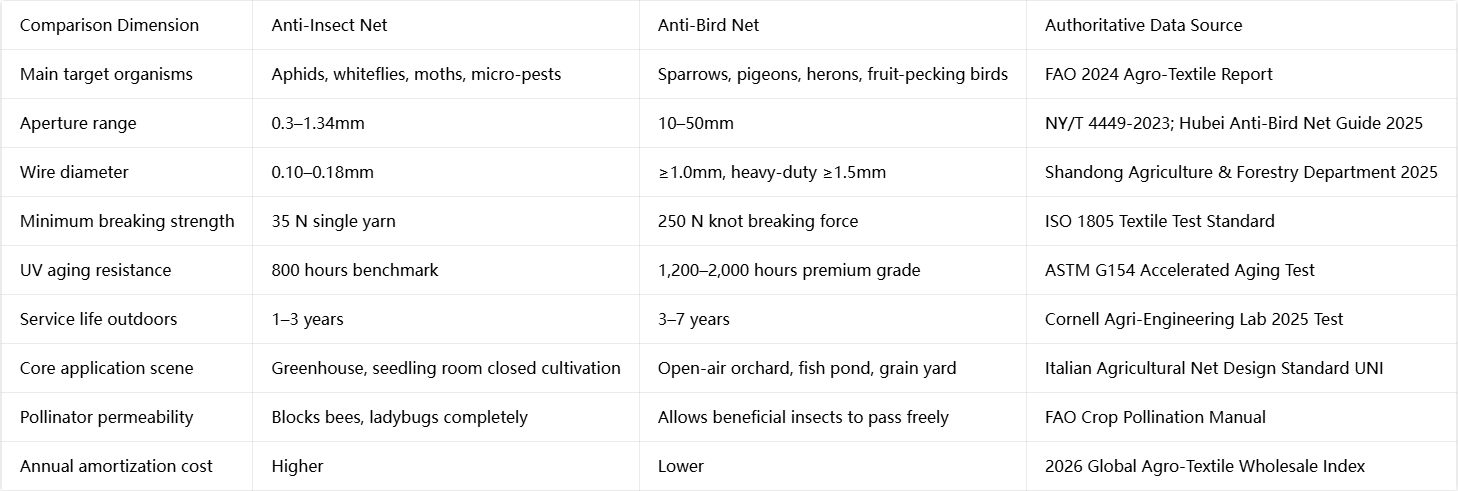
ConclusionThe essential difference between anti-bird nets and anti-insect nets lies in design target: anti-insect nets prioritize micro-pest physical isolation with ultra-fine thin wire mesh, suitable for sealed small-space facility agriculture; anti-bird nets focus on bird impact resistance and open-air light ventilation with thick knotted wide mesh, matching large-area fruit and aquaculture production. Growers, wholesalers and agricultural engineering practitioners must select nets strictly based on crop types, planting environments and hazard objects, rather than adopting universal netting.
Incorrect matching will not only raise repeated purchase and maintenance costs but also trigger crop yield reduction, pollination obstacles and even legal risks of violating wildlife protection regulations. All technical parameters cited in this article are extracted from official agricultural industry standards, international textile testing ISO/ASTM norms, FAO global agricultural textile research reports and university agricultural laboratory independent test data, providing reliable quantifiable reference for scientific agricultural net selection and popularization.